illustrations by wendy martinillustration portfoliosbooksschool visitsart processdaily art food blogcontact wendy martinabout wendy martinartist friends and resourcesart shop and gallery

illustrator interviews

Interview with illustrator Wendy Edelson

Sunday, February 21st, 2010

(Sorry this interview is a little late in being published. It seems that every working artists I know has very tight deadlines this month. — Including me!)

Please extend a warm welcome to a fabulous artist and friend of mine, Wendy Edelson.

Wendy Edelson Studios Wendy Edelson

Born 6 weeks early, Wendy Edelson spent her first couple years in New York, then moved with her parents to California, It was there in the back of the station wagon with the country speeding past the windows that she began to draw, and draw…and draw and hasn’t stopped yet.

She now lives on Bainbridge Island and has recently begun licensing  her images for all sorts of products, such as puzzles, cards and banners  and  is currently busy with her new favorite passion, creating  fabric collections.

Visit her at http://www.wendyedelson.com/

When did you get started illustrating for children? What did you do before?

I illustrated my first book, “Whose Garden” published by Harvey House in New York when I was 18, following my first trip to New York with my portfolio.

Tell us a little bit about the recent book you illustrated, “Saturn For My Birthday”

“Saturn For My Birthday” by John McGranaghan/Sylvan Dell, is an amusing story about a small boy who asks his father for the planet Saturn for his birthday. Using humorous situations, facts about the planet are presented.

What are you working on right now? Do you have any other books or art projects you’d like to talk about?

I have recently completed illustrating “Bartholomew’s Gift” by Diane Dignan  and  I am about 2 days away from completing the illustrations for “Pobble’s Way” by Simon VanBooy.

page illustration from the book Bartholomew's Gift page illustration from the book Bartholomew's Gift Bull's head illustration for pop-up book

I am also working on the illustrations for a pop up book about Bahrain, a commissioned “shaped puzzle” and a new fabric collection.

Your artwork has been showing up as puzzles and other items. What project are you currently involved in? How do these usages differ from picture book illustration?

The puzzles are really something I enjoy…..this will be the third commissioned shaped puzzle that I have done. I enjoy painting “one offs”, pieces that stand alone and  have a LOT of detail. It’s sometimes a bit of relief to only paint a character once!

I’m also working on my second fabric collection. I love doing these, The first was a Christmas collection, this is an Animal ABC, for a soft book, quilts and accompanying print fabrics.

The lovely thing about licensing is that one piece of artwork can be used as a puzzle, as fabric, as a card etc etc…..it’s wonderful to have them out there earning their keep, rather than sitting in a flatfile, or even on a wall after a book is published.

I also do pet portraits.

pencil sketch for Rich and Duff - pet portrait final art for Rich and Duff - pet portrait

The guy on the motorcycle with the Wheaton Terrier in the sidecar was a pet portrait. Richard owns the local art supply store and rides around with Duffy in the side car. This was a pet portrait I did for him. I included my sketch, as well…this is what my finished drawings look like
before I paint them.

You spent a while living in Mexico. How long did you live there? How has living outside of the USA influenced your art?

I lived in Mexico for a little over 3 years.

I did write my first picturebook while I was there, “The Cajeta Colored Dog Who Loved Tortillas” The book is set in the  town where I lived so it was wonderful  drawing everything. The colors are what really have stayed with me……my kitchen was painted Rosa Mexicana, which is a deep, vivid pink, it made perfect sense there. The memory of bright orange and salmon bougainvillea spilling over a turquoise and violet wall is one that I think of often. Also Pitahaya, an amazing cactus with hot pink and lime green fruits…inside they are bright white with black flecks. The colors were truly swoon worthy.

Do you illustrate full time? If not, what else do you do?

Yes, mostly 7 days a week, unless I’m  in a garden.

When you illustrate a picture book how do you decide what scenes and details to draw?

I spend a few weeks reading and rereading the story, thinking about it all the time while I’m doing everything else and it seems as though the story reveals itself to me, scribbling blobby shapes that would make sense to no one else helps the process…..mostly it seems to simply evolve, either it feels right or it doesn’t.

When illustrating picture books do you include a visual storyline not mentioned by the text or include animals or people you know?

Yes, I do. In Saturn there is a group of pets that are never mentioned in the book, In The Cajeta Colored Dog I have added people I know in the scenes of people in the shops…..that’s one of the really fun things about being an illustrator. Once I wrote all sorts of little messages in the bark of trees.

Can you explain your art process?

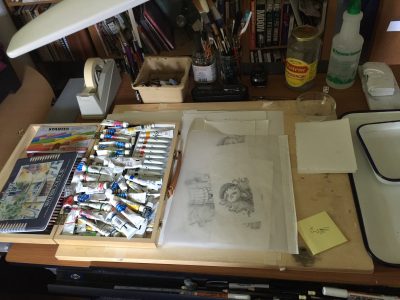
All my work starts out with a very finished, detailed pencil drawing on  my favorite Clearprint Design Vellum. I LOVE this paper because we all have days when we must draw a foot 25 times to get the foreshortening right and one can erase and erase on this paper and it doesn’t ghost or become damaged in any way. Once I have my drawing how I want it I scan it and then print it out on one of my beautiful Epson wide format printers right onto 140 lb watercolor paper, usually in a light Sepia. I vacillate between papers and cold and hot press, depending on …what’s left in my flatfile, my mood….the piece itself. I love being able to do this……it used to take so much time to trace my own drawing on a light table , besides being mind numbingly boring, plus every generation away from the original sketch takes away from the freshness, life, of the line, I think.

All the pretty paint and painting techniques cannot make up for a stilted drawing….I think. Great drawing is the most important part, to me……one can pull anything off if the drawing is good. My father was a wannabe, weekend sculptor and we used to draw together all the time…he was a big stickler for accurate anatomy and good draughtsmanship.

Do you have a favorite color or palette?

Not really….but I do love granulating watercolor pigments, love the mystery and surprise of them.

What is your favorite medium to work in? Have you always worked in this media? If not, why did you switch?

I started out just drawing. When I was 13,  the father of a friend in school was artist Henry Koerner. He introduced me to rapidographs, technical pens and I used them for years, most of my work was black and white. Then I found Dr Martin’s dyes and Luma colors and started using those with the pen line and then I began teaching myself about watercolors. Those have been pretty much my mainstay, but the black line became a sepia line. The rapidographs gave way to very fine line brown, waterproof markers which now have pretty much disappeared, except for  occasional use just on the outside contours of a person or animal. Now I use watercolors in combination with Golden liquid acrylics and everything is build up of glazes. Occasionally I’ll use colored pencils in the mix, as well.

Did you always want to be an artist when you grew up?

Yes, I began drawing in the back of the family station wagon when we moved from New York City to Southern California when I was two. After that trip, I spent pretty much every waking moment drawing.

Do you use models/source pictures or do you draw from your memory/imagination?

Yes, I draw people, animals, landscapes from life and also use photos that I take and from magazines, the internet etc……my work is stylized but definitely realistic, so I like to know how things really look, to start with.

If you could be anything other than an artist, what would you be?

Some sort of landscape designer…….my second favorite thing is gardening.

What gets you through an illustration when you’re stuck for inspiration?

Sheer Taurean grit and determination. One of the blessings of being an illustrator are deadlines. Deadlines have no patience with waiting for one’s Muse to make her appearance. Sometimes one simply has to work through it and waste a bunch of paper, but the effort is almost always worth it. A looming deadline can be very motivating.

What book do you remember from when you were young?

The Wonder Clock illustrated by Howard Pyle.

Is there a children’s book illustrator whose work you gravitate towards in the bookstore now?

I love looking at the work of artists like David Shannon …I’d love to be freer, more able to exaggerate features and bodies , to loosen up more.

It’s all a process….I suppose when one finally totally arrives and has nothing left to learn, I guess one is ready to shuffle off this mortal coil

If you could illustrate any writer’s new work, who would it be?

I’d love to illustrate another book for Simon Van Booy, the author whose book I’m currently finishing up…..

Children’s book illustrator – John Lechner

Wednesday, January 20th, 2010


Say a big hello to John Lechner. He is the author and illustrator of four books for children, A Froggy Fable, Sticky Burr: Adventures in Burwood Forest, The Clever Stick and Sticky Burr: The Prickly Peril, all published by Candlewick Press. Thank you for joining us today.

When did you get started illustrating for children? What did you do before?

My first book, A Froggy Fable, was published in 2005, but I have been writing and drawing my whole life. Before being published, I worked as a graphic designer, puppeteer, animator, interactive designer and art director.

Tell us a little bit about the recent books you wrote and illustrated, The Clever Stick and Sticky Burr: The Prickly Peril.

The Clever Stick is a fable about a stick who is sad because he cannot speak. He has many thoughts he wants to share, but doesn’t know how. In the course of the book, he discovers his “voice”. My other recent book, Sticky Burr: The Prickly Peril, is about a group of burrs who live in the forest, and what happens when their village is attacked by the wicked Burweena and her spiders. It’s part comic book, part storybook, part nature journal.

What are you working on right now? Do you have any other books or art projects you’d like to talk about?

Right now I’m working on a novel, which is very different from my other books. I also launched a blog last fall called The Untended Garden, where I highlight artists and writers inspired by nature. I think it’s ironic that even though we know more about nature than ever before, we are becoming more and more isolated from it. Art and literature have always helped us see our world in new ways, and I hope to bring that sense of discovery and exploration to today’s readers.

You work in animation and interactive storytelling. What project are you currently involved in? How do these disciplines differ from picture book illustration?

Lately I’ve been very interested in interactive storytelling, combining the elements of an illustrated book and an animated film into something new. I’ve been working on my own interactive story for over a year now, which I hope to launch this spring.

I love animation because it’s a unique kind of visual storytelling, and combines many different art forms. It is a lot like book illustration, except you multiply the number of illustrations exponentially, and look at them REALLY fast. You are still telling a visual story, but showing every action and scene, leaving less to the viewer’s imagination. In this way, it is a less intimate experience than reading a book, since much of a book’s reality takes place inside the reader’s imagination. But you can also add things to animation like music and sound effects, which can enhance your story in ways that a book can only dream of.

Do you do non-children’s book art (licensing, fine art, etc.) or art just for fun? Is that art similar or different from your children’s book art?

Besides book illustration, I love to draw and paint for fun. I like painting with watercolors outdoors, though I don’t have much time for it. You can see a lot of my miscellaneous work on my website gallery http://www.johnlechner.com/gallery/index.html. It’s not too different from my children’s book art, but a bit more eclectic.

Do you illustrate full time? If not, what else do you do?

I work full-time as an Art Director at the children’s media company FableVision. There I do everything from animation to web design. One of my recent projects was designing a new website for Mister Rogers’ Neighborhood which was very exciting and humbling to work on. My latest project is co-directing the animated film The North Star, based on the book by Peter H. Reynolds, which will be released later this year.

When you illustrate a picture book how do you decide what scenes and details to draw?


I usually visualize the story in my head, and draw what I see. There is no system or structure to my sketching, I just try out different views and angles until I have something that flows together. I try to give each scene some visual drama, even if it’s just a field of flowers. And it’s important for the drawings to work together as a sequence, both visually and dramatically. You can’t just focus on each page as a self-contained picture, you always have to think of how it fits into the book. That’s what separates great picture books from ordinary ones, when the pictures flow together so seamlessly that you don’t even notice you’ve turned the page. That’s something I’m still striving for.

When illustrating picture books do you include a visual storyline not mentioned by the text or include animals or people you know?

I draw many things that aren’t in the text, such as recurring background characters, or changes in color or composition to reflect the mood. Since most of my stories are about animals or insects, I don’t usually include people that I know (at least, not consciously!)

Can you explain your art process?

After I have the final sketch dummy (which is the result of many revisions with pencil and paper), I will sketch out the final illustrations on watercolor paper, actual size. I prefer actual size because I like to work small, and it also shows me exactly what the final page will look like. After sketching, I will draw the final lines using black India ink and a fine brush. Then I will erase the pencil lines, and paint the illustration with watercolor. I usually work on several paintings at a time, since the watercolor has to dry after each section so it doesn’t run. I will often do the whole illustration over, if it doesn’t turn out the way I want. I think the entire book A Froggy Fable was illustrated twice, because I wasn’t satisfied with my first attempts.

Do you have a favorite color or palette?

Most of my stories take place outdoors, and I love greens and browns, especially yellow ochre.

What is your favorite medium to work in? Have you always worked in this media? If not, why did you switch?

I prefer watercolor and ink, which I have used for all my books. I’ve tried other mediums over the years, but watercolors seem to best express the ideas and feelings that I’m trying to convey.

Did you always want to be an artist when you grew up?

Yes, along with a musician, puppeteer, writer, filmmaker, and many other things.

Do you use models/source pictures or do you draw from your memory/imagination?

I mostly draw from my imagination, though I often model my scenery on real places. For instance, the tree at the beginning of The Clever Stick is an old apple tree from my backyard. And for the Sticky Burr books, I research all the animals and insects that I draw, then simplify them to make them fit the style of the story.

If you could be anything other than an artist, what would you be?

If I weren’t making books, I would love to be a musician and composer. I play the violin, guitar and ukulele, and I actually wrote the songs in the back of my Sticky Burr books.

What gets you through an illustration when you’re stuck for inspiration?

Deadlines.

What book do you remember from when you were young? (list one or multiple books)

I had many favorite books as a child, including everything by Richard Scarry, Bill Peet and Dr. Seuss. I liked books with lots of visual details, but also a good story.

Is there a children’s book illustrator whose work you gravitate towards in the bookstore now?

I’m always drawn to illustrators whose work is very different than my own, particularly those with a bold sense of texture and design like Lane Smith or Melissa Sweet. I love artists who can create a unique world that the reader can get lost in.

If you could illustrate any writer’s new work, who would it be?

Lately I have been very inspired by Diana Wynne Jones. Her writing is so rich, so imaginative, it would be an honor to illustrate even a single sentence of hers.

Who do you want to be when you ‘grow up’?

I don’t plan to.  In fact, I think I might start growing younger instead of older, and spend more time making things, jumping in puddles, and exploring the world around me.

Interview with Children’s Book Illustrator – Cyd Moore

Wednesday, December 16th, 2009

Cyd MooreIllustrator Cyd Moore has generously shared her time with us today. She has dozens of books to her credit. Her whimsical style has always been one of my favorites. You can visit her at her web site CydMoore.com.

When did you get started illustrating for children? What did you do before?

I’ve been illustrating children’s books for about 25 years. I’m also a graphic designer and worked in advertising, newspaper, and television.

You have a book planned for 2010 called Arbor Day Square. This book is about the founding of Arbor Day, right? Did you do a lot of research about the time era to get the clothing and environment correct?

arborcover115_pioneer_woman

I poked around in the 1800’s for weeks! Even with my wacky style, I feel that I should accurately represent the period as much as possible. I had a five inch stack of printouts with trains, store fronts, gingham and calico fabrics, dresses, school houses, toys, mules, wagons. It was fun learning more about those pioneers—they were a tough bunch!  I wonder if folks today could handle such a hard life! Above is a pic of a hard working lady from the 1800’s that was tacked on my board during this job—she was my inspiration for making the deadline! She’s pushing buffalo dung!!! She does not whine about her life—she does not expect someone else to take care of her. She is tough and strong and determined to do whatever it takes to keep her babies warm!!!! I LOVE her!

You work on a series of books for a character called Stinky Face. Can you tell us about that character? Are there more Stinky Face books planned?

books_lovestinky_cvrxl books_missstinky_cvrxl books_cvrsxl_stinkyface

Stinky Face all began with I LOVE YOU STINKY FACE, written by Lisa McCourt. I liked that it’s such a sweet story without being sentimental.  The little boy says, ‘Mama, what if I was a super smelly skunk and I smelled so back that everybody called me Stinky Face?’ She bathes him in bubble bath and sprinkles him with powder, but he still smells bad, of course. This is how he came to be known as “Stinky Face!”

HapHalloCover copyI’ve been told by many parents that kids get hooked on Stinky Face and read it every night!  Hundreds of thousands of copies have been sold, so there are a lot of little ones curled up with their moms and dads reading Stinky—this makes me smile! Currently there are 5 versions of Stinky Face, including Halloween and Christmas versions. I’m working on 2 Stinky readers which will be out in July and December 2010. Stinky is growing up—he’s going to kindergarten!

What are you working on right now? Do you have any other books or art projects you’d like to talk about?

Soon, I’ll be working on a sequel for WILLOW for Sleeping Bear Press. The first WILLOW did quite well, winning lots of awards. Check out the cute site: www.willowlovesart.com.

art_willow_drawsXL

I’m also working on another fun project for Sleeping Bear, but don’t know the title yet. Also a few magazine jobs and doing some graphic design projects.

Do you do non-children’s book art (licensing, fine art, etc.) or art just for fun? Is that art similar or different from your children’s book art?

I’ve done a lot of advertising work—McDonald’s happy meal boxes, Burger King ads, telephone book covers, etc. Also, lots of editorial work for magazines and newspapers. I enjoy painting canvases in oils and acrylics, but I don’t have much time for it. The style is rather whimsical—it’s what I do, I suppose.  Illustrating children’s books takes most of my time for many years now—I usually do 3-4 per year. I’m writing also, and developing my own projects.

SnowMCovercopy

Here's a magazine cover from the past—I did 8 of these over the years...all with this snowman in various Chicago scenes—fun job!

BurgerKing copy

Burger King artwork

PhonebookCovers

Several phone book covers

Do you illustrate full time? If not, what else do you do?

Yes, full time many years. Now and then a graphic design job comes across my desk, but mostly children’s books. I feel so blessed to have a job that amuses me every single day!

I also do a lot of appearances at schools, libraries, and conferences. Meeting the kids, teachers, and parents who enjoy the books is such a treat. This is one of my favorite things about publishing—sharing my passion for art and reading with kids. The school program is really fun—lots of storytelling, art from when I was a child up to the most recent work on my drawing board. Lately I’ve been doing something a little different—Skype interviews with classrooms! These have been really fun! Just last week I was talking with a third grade class down in Atlanta, and I was sitting at my drawing table here in Michigan!

When you illustrate a picture book how do you decide what scenes and details to draw?

It’s hard to answer this question, because I don’t really ‘decide’ anything. It’s a very intuitive process—not cerebral. There is no ‘how to’ guide, but I can tell you how I eventually get there!

Everything, of course begins with the author’s text. Reading the story, I sketch and doodle any ideas that pop up—even if they are silly or bad! No editing during this phase, no filters, and nothing has to be perfect.  There definitely ARE good ideas and bad ideas, but all of them go down. The good ones keep you moving forward.

I believe this phase is necessary for any creative project. You can think and plan and scheme and fret. But until you actually move the pencil across the paper, or pick up a wad of clay, or paint brush, nothing really happens. Pushing that pencil generates concrete ideas. I spend more time during this phase than I do actually painting the books.

So, I put everything down, move it all about, taking bits and scraps from some and put them with others, and eventually it becomes a book. If I start thinking about it too much, or planning too much, I feel like I’m trudging through deep mud. PLAY is the process…play with the ideas that come—light and free and unattached. Sometimes, I’m amazed at what shows up to the party!

SecretJournal copy

Funny page out of a journal after I watched THE SECRET!

When illustrating picture books do you include a visual storyline not mentioned by the text or include animals or people you know?

An illustrator must follow the author’s story line of course. BUT, I believe good illustrators aren’t simply translating the author’s words. They illuminate the words—making them bigger than they were alone. Picture books don’t have many words, and kids won’t sit still for long descriptive passages. The picture book illustrator’s job is to place the story in a world, building the emotion and action. The art visually inspires little (and big) readers to take this journey for a little while. Alone, the story is the story and the art is the art. But put them together, along with editor and art director input, the book becomes something much bigger than the separate parts. The book is the art form.

Can you imagine GO DOG GO without the dog party in the tree? Or WHERE THE WILD THINGS ARE without Max in his wolf suit? ALICE IN WONDERLAND is always ALICE IN WONDERLAND, but a Disney version of ALICE is a completely different world from Barry Moser’s ALICE. And I can’t wait for Tim Burton’s wild ride! The visual impact on any story is extremely powerful.

And yes, my pets and friends show up in books!

Can you explain your art process?

After all of the ideas are worked out for each page, I do a fairly tight pencil sketch of each spread at 100% scale—no color at this point. I make copies of all pages, and put them together as a dummy to send off to the publisher. After all of the sketches are approved, I transfer them to Lanaquarelle 300 lb hot press watercolor paper and paint in watercolor, gouache, and Prismacolor pencil.

Do you have a favorite color or palette?

Not consciously.

What is your favorite medium to work in? Have you always worked in this media? If not, why did you switch?

Always watercolors, gouache, Prismacolor pencils and sometimes ink for commercial jobs. It’s quick process. I LOVE to paint in oils, but I never use it for commercial jobs.

Did you always want to be an artist when you grew up?

I’m lucky that way. I always knew that I would do something in the art field. I was drawn to art therapy for a while when I was in college, but went with graphic design instead. I think children’s books can be very therapeutic!

Do you use models/source pictures or do you draw from your memory/imagination?

It really depends on the book. Most of the time, I’m just drawing out of my head. Many of my books are whimsical and silly, so imagination is the key. I use reference when I need it. The internet has made research so quick and easy. Last week, I had to draw a rainbow, and I swear I can never remember the order of the colors. I realize there is some tricky formula for this, but if I can’t remember the colors, how can I possibly remember the formula? Of course, the older I get, the less I can remember a lot of things!

Cyd Moore

If you could be anything other than an artist, what would you be?

A landscape architect or a botanist.  I became a Master Gardener last year—the program was so fun!

What gets you through an illustration when you’re stuck for inspiration?

The worst thing, of course, is to sit there and fret over it.  It helps to always be working. Taking time off away from the studio makes you rusty. As long as you’re in the room, experimenting, banging away at ideas, the rust fall away and ideas come more easily. Also, no talking about projects to others. I don’t enjoy brainstorming or sharing thoughts in the beginning. The good energy dissipates. It’s much better for me to put that energy into the project and then share the first sketches with others. Otherwise, I get too cautious, or side tracked trying to fulfill someone else’s vision.

That’s not to say I’m not open to input from editors and art directors. I’m quite excited to receive comments and suggestions after the first sketch stage. I simply mean that it’s better for my process to wait until I’ve put down my own ideas first.

What book do you remember from when you were young?

GO DOG GO and GREEN EGGS AND HAM were 2 of my favorites as a little kid. Later, I loved THE SECRET GARDEN. When my boys were young, we LOVED all things Roald Dahl, but especially The BFG. (The Big Friendly Giant)

Is there a children’s book illustrator whose work you gravitate towards in the bookstore now?

Maurice Sendak and Quentin Blake are always two of my forever faves.

If you could illustrate any writer’s new work, who would it be?

A really famous celebrity who writes well and gets their face on TV screens constantly!!!! No matter how wonderful the author and story, if people don’t buy the book in the first year, the publishers don’t keep it around long these days. Jamie Lee’s stories have made Laura Cornell a very happy illustrator over the years!

books_alicegreta_cvrxl

TV is so quick, effective and persuasive. I experienced this myself with a book called ALICE AND GRETA. The author appeared on Regis and Cathy Lee and on one of the morning news shows—the Today Show maybe. I had several book signings at that time and SO many people showed up wanting that book. I had other books that were really cute—I LOVE YOU STINKY FACE had just been published. But because folks saw ALICE AND GRETA on TV, that’s the one they wanted! Of course the book has to be good in the long run. Some celebrities have written some rather awful books, and after the big push in the beginning, the books quietly disappear.

Who do you want to be when you ‘grow up’?

Wise.

Holiday Cyd

Thank you for a wonderful interview, Cyd. Have a wonderful holiday!

Interview with Picture Book Illustrator Bonnie Adamson

Wednesday, November 18th, 2009

When did you get started illustrating for children? What did you do before?

BonnieI started putting together a portfolio and joined SCBWI in 2000. Before that, I was a freelance graphic (print) designer and business writer: catalogs, ad copy, brochures, newsletters, etc. I am fortunate to have had clients (a children’s dance company, a local university) whose projects gave me the nucleus of a portfolio, so I didn’t start totally from scratch.

Tell us a little bit about the recent books you illustrated, the I Wish for Boys, and I Wish for Girls series.

Tall cover Strong cover
I wish I was tall like…
I wish I was strong like…

The opportunity to illustrate the first two books came about because I had done two small work-for-hire jobs for Raven Tree, and so was on the list when a call went out to submit sketches on spec.

Glasses cover Freckles cover
I Wish I had glasses like… I wish I had freckles like…

The “I Wish” girls’ books were released simultaneously, as companion books from the point of view of each of the two best friends. Each admires something about the other: one thinks her friend’s glasses are cool, and wishes she wore glasses, too; the other thinks having freckles like her friend would be really neat. When the books did well, Raven Tree asked the authors to write a companion set for boys as well.

I understand these books repeat characters across the series. What was the first book? How do you work at making a previously secondary character become the main character? Are there more books planned?

The two girls and the two boys were costars — we made sure each had equal “face time,” so neither was ever really secondary within their respective sets. There was a bit of a subtle crossover from the girls’ books to the boys’: one of the girls’ books mentions “a neighbor’s dog.” The dog shows up in the boys’ books as belonging to one of the main characters—and there’s a scene at school in one of the boys’ books where you can see the two girls, Abby and Rosa, in the background. So the illustrations imply that they all know each other.

I haven’t heard of plans to continue the series, but they are all being re-released in English-only editions (the originals were bilingual).

These books are not typical picture books. How do they differ from other books in the genre?

In general, you don’t worry about reading level in a picture book, because most are meant to be read by an adult, to a child. But because these books were originally planned as bilingual books, they have potential for use as teaching tools, for both English-speaking and Spanish-speaking children (and adults, as well—picture books are often used in adult ESL programs). So not only does the text have to be carefully planned to conform to a reading level (second grade, in this case), but the illustrations must support the text more literally than would perhaps be usual. Readers are looking for clues in the pictures: if the text mentions finding a ball under a bed, the illustration must show a ball under a bed.

Otherwise, the format is the same.

What are you working on right now? Do you have any other books or art projects you’d like to talk about?

Bedtime cover

I’m finishing up illustrations for another picture book from Raven Tree: Bedtime Monster, by Heather Ayris Burnell. This book will also be released in both bilingual and English-only editions.

Do you do non-children’s book art (licensing, fine art, etc.) or art just for fun? Is that art similar or different from your children’s book art?

No, I wouldn’t say I do art just for fun. I do have a good bit of non-commissioned work, but all are done specifically as portfolio pieces. My background is in art for print; I’ve never given much thought to archival issues, for instance. But I understand that Raven Tree has entered into an agreement with a gallery to sell original art from their books, so in order to be on board, I’m having to rethink how I approach the art for this current book. I need to be more aware of maintaining viable, archive-quality originals.

Do you illustrate full time? If not, what else do you do?

I write, as well. My “magnum opus” is a middle grade historical, which was hugely satisfying to work on. I also have a couple of clients from my freelance days who have stuck with me, so I still do some graphic work, although I’m not actively pursuing design work outside of children’s publishing now.

When you illustrate a picture book how do you decide what scenes and details to draw?

I start by story boarding thumbnails. A good picture book is written in scenes, so it’s not so much a question of choosing which scenes as of figuring out the emphasis within a scene. It helps me to think cinematically: where would the camera be positioned, and is it a close-up, or a wide-angle shot?

I prefer vignette illustration without much background (when I can get away with it!), probably because of my experience doing spot illustrations for magazines, etc.

When illustrating picture books do you include a visual storyline not mentioned by the text or include animals or people you know?

The illustrations for the Raven Tree books enlarge on the text, but do not carry a specific subtext. I gave both boys dogs, which weren’t in the text, simply as a way of livening up the illustrations.

It’s always fun to throw in something personal. The crossover dog I mentioned from the “I Wish” series is my much loved and recently departed golden retriever. I was able to work her into Bedtime Monster, too—as the cover illustration on a book in the main character’s bedroom.

And, of course, I see a little bit of my two daughters in all my characters.

Can you explain your art process?

a character sketch sheet from Bonnie's sketch book

a character sketch sheet from Bonnie's sketch book

I’m a sketcher. I obsess over the line work, and truthfully would be happy to stop there. I long ago fell in love with 2B lead on Bienfang parchment paper, and am thrilled that I can preserve the line quality by scanning, since that’s hardly a stable medium. Since I like to draw very tightly and use the drawing as a blueprint for the looser painting to follow, the drawing stage takes up most of my time.

You can see more work on my website: http://www.bonnieadamson.net.

Do you have a favorite color or palette?

Besides b/w line, I’m very loyal to cobalt blue, phthalo blue, Hooker’s green and sap green; plus a “dirty palette” of burnt and raw siennas, and burnt and raw umbers that I never clean away, for hair and skin tones.

What is your favorite medium to work in? Have you always worked in this media? If not, why did you switch?

In the early days of freelancing, I had many pre-separated two-color jobs, so I had to develop a consistent style for pen & ink (early copy cameras could not pick up the subtleties in pencil line). I settled on watercolor wash as a way to introduce color, and have gradually become more comfortable with watercolor as a medium. I’m most likely to combine it with pencil, colored pencil or pen and ink (Micron pen, nowadays). I used to enjoy flat-color collage for design projects, and have recently been experimenting with vector shapes in Photoshop as a way of getting back to that collage feel.

Did you always want to be an artist when you grew up?

No, I always drew, but I never considered art as a career. I was an English major, and intended to work as a magazine editor. When I couldn’t find a job right away, I went back to school and got a second degree in graphic design, figuring that would be good collateral experience. I did end up working as a reporter for a medical business news magazine, briefly, before starting my freelance career. By that time, I was more interested in the design end. As a freelance art director, I was pretty cheap and frequently did my own art to avoid hiring an illustrator. So that’s how I ended up illustrating.

Do you use models/source pictures or do you draw from your memory/imagination?

"Maya" copyright © Bonnie Adamson

"Maya" copyright © Bonnie Adamson

I try not to draw directly from source materials. I remember another illustrator, talking about drawing a rooster. He said he did the research on roosters, but, in the end, he needed to draw the “rooster of the mind.” So I gather lots of images, but then don’t look at them as I draw. I’m always surprised at the details I manage to dredge up once I start drawing, and I feel that because they stand out in my mind, they’re probably the salient details needed to define whatever it is.

If you could be anything other than an artist, what would you be?

I’d love to be an image analyzer for NASA’s Jet-Propulsion Lab. That would be my little behind-the-scenes contribution to space exploration. Either that, or join the crew of the Enterprise.

What gets you through an illustration when you’re stuck for inspiration?

Trial and error. I can’t think my way through. I just keep sketching until something looks right or sparks an idea.

What book do you remember from when you were young? (list one or multiple books)

Oh, golly. I was a reader. Visually? I loved my Little Golden Book collection fiercely, was addicted to Dr. Seuss, and I think my style is still influenced by vintage Platt & Munk poster-style illustrations in some of the children’s books I inherited from my mother. I was a huge comic book fan, too.

Is there a children’s book illustrator whose work you gravitate towards in the bookstore now

I’m impressed by draftsmanship, so illustrators who use line well stand out for me: Marla Frazee and Nancy Carpenter are two that come to mind immediately. There are so many beautiful books out there.

If you could illustrate any writer’s new work, who would it be?

Me! I’d love to do the b/w interiors for my historical novel. :-)

Who do you want to be when you ‘grow up’?

My family has heard me say I want to end my days with a pair of binoculars on a coastline somewhere, counting whales for National Geographic. Between now and then, who knows? I’m up for anything!

Interview with Author/Artist Matt Phelan

Wednesday, October 21st, 2009

Today’s interview is with award winning artist Matt Phelan. He recently had his first graphic novel released and was gracious enough to spend some time answering questions about his art and his career path.

When did you get started illustrating books for children? What did you do before?

I began illustrating full-time in 2004. Just prior to that, I was an editor and copywriter for the admissions office of a university.

You have a new book out The Storm In The Barn. This is the first book you also wrote. Please tell us a bit about it.

Candlewick Press 2009

Candlewick Press 2009

The Storm in the Barn is a graphic novel set during the Dust Bowl era. It is part historical fiction, part fable, and part supernatural thriller.

The Storm In The Barn is a graphic novel. How does illustrating a GN differ from a picture book?

Apart from the size and sheer volume of drawings, the real difference is in how you are manipulating individual panels to guide the reading experience.

You illustrated The Higher Power of Lucky, which went on to become a Newbery Medal award winner. How has this changed your career?

I think, within the publishing industry at least, my name recognition shot up considerably on the day that was announced.

The Higher Power of Lucky is a novel. Is illustrating a novel in black in white much different than illustrating a picture book? How do you approach the differences?

The main difference is that with a novel you are adding accents to a scene, trying to enhance a particular moment, or add a moment to complement the text. With a picture book, you are doing that, but you are also responsible for creating the entire world of that book.

What are you working on right now? Do you have any other books or art projects you’d like to talk about?

I am illustrating a new picture book by Ann Stott (author of Always), the third Lucky book by Susan Patron, and my next graphic novel which is called Around the World and is based on three true stories of 19th-century globetrotters.

Do you do non-children’s book art (licensing, fine art, etc.) or art just for fun? Is that art similar or different from your children’s book art?

I draw as often as I can and I wish I took more time to just draw for the sheer pleasure of it. Many of my non-book drawings wind up on my Planet Ham sketch blog. I haven’t done any licensing work or “fine” art.

from Matt Phalen's sketch book

from Matt Phalen's sketch book

Do you illustrate full time? If not, what else do you do?

I am fortunate enough to do this full time.

When illustrating picture books do you include a visual storyline not mentioned by the text or include animals or people you know?

It’s always nice to add something to a picture book, something the author may not have even thought of (as long as it is true to the book). I added a dog as a sort of comic foil to the picture book Always, but he wasn’t based on any real animal. Some friends have noticed similarities to some real people in my books, but I never do that intentionally.

On your blog (http://planetham.blogspot.com) you do a series called Monkeys of the World. What was the inspiration for that?

That was actually originally done as a gift for a friend (it was a calendar). I just thought the idea of showing the indigenous monkeys of such places as Michigan and The Hague was funny.

Monkeys of the World: Calcutta — Matt Phalen

Monkeys of the World: Calcutta — Matt Phalen

Do you have a favorite color or palette?

I prefer a more muted palette when it’s appropriate, but I let the book dictate what I should use.

What is your favorite medium to work in? Have you always worked in this media? If not, why did you switch?

I generally use watercolor which is fascinating and frustrating. I used pastel pencils for Very Hairy Bear and found that to be a lot of fun. I hope to have a chance to use them again.

Do you use models/source pictures or do you draw from your memory/imagination?

I’ll occasionally use reference photos to see what an object or place looks like, but then I’ll filter it through my own style. I don’t use models.

What gets you through an illustration when you’re stuck for inspiration?

If I’m really stuck, I’ll go for a walk, think about a different problem, or look at books or other general forms of inspiration. But I’ll get back to the problem soon. The solution always involves just sticking with it.

If you could illustrate any writer’s new work, who would it be?

I probably wouldn’t turn down a book by Neil Gaiman.

What one piece of advice would you give to an illustrator just starting out?

Focus on making your portfolio the best it can possibly be. That’s the one thing you have complete control over. It’s also the one thing that will get you work.

Thank you for spending time with us, Matt.

Get Adobe Flash playerPlugin by wpburn.com wordpress themes

Copyright © 1992 - 2009 All rights reserved. Wendy Martin illustration.
Member of: Society of Children's Book Writers and Illustrators, Graphic Artist Guild and St. Louis Watercolor Society.
Powered by WordPress | Based on a theme by RoseCityGardens.com